Abstract
Modern precision manufacturing continuously pursues higher dimensional consistency and fewer clamping cycles for complex mechanical parts. Vertical Dual‑Axis Compound Machine integrates multi‑axis motion control and mixed machining functions inside one machine frame, reducing repeated workpiece repositioning during production runs. This content explores its structural traits, core machining capabilities, suitable workpiece types, operational considerations and practical setup advice for manufacturing engineers and workshop technicians.
Table of Contents — Click each item to jump to corresponding section
- 1. Structural Layout And Integrated Machining Logic
- 2. Core Performance And Technical Specifications
- 3. Advantages For Complex Precision Workpieces
- 4. Common Production Application Fields
- 5. Machine Setup And Daily Operational Best Practices
- 6. Frequently Asked Questions
- 7. Technical Support Inquiry
1. Structural Layout And Integrated Machining Logic
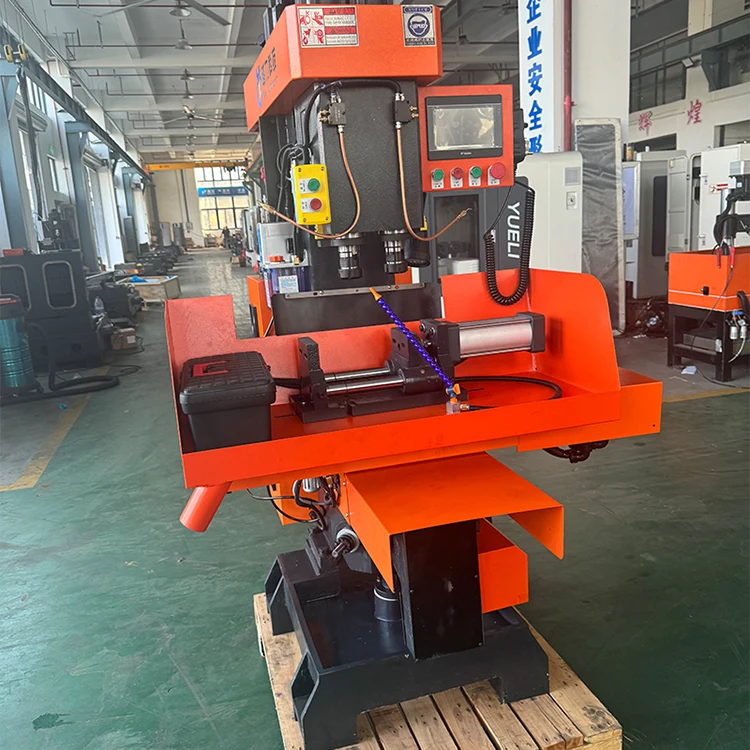
Traditional machine tools often separate turning, milling and drilling processes onto independent equipment. Workpieces must be dismounted, re‑aligned and clamped multiple times when multi‑feature machining is required. Each re‑clamping step introduces potential positional deviation and extends overall processing cycles. Vertical Dual‑Axis Compound Machine brings different cutting operations into a single working envelope, completing diverse feature machining without repeated part handling.
The vertical frame structure delivers stable mechanical rigidity against cutting force vibration. Two coordinated servo‑driven axes support synchronized motion during composite cutting paths. Tool changing mechanism allows switching between different cutting tools within one program cycle, covering outer profile turning, face milling, hole drilling and tapping tasks for one single workpiece fixture setup. Advanced CNC control unit interprets complex G‑code programs to coordinate spindle speed, feed rate and dual‑axis movement synchronously.
Machine frame reinforcement and vibration damping components suppress resonance generated during heavy‑load cutting. Such mechanical design keeps stable positional accuracy even under continuous long‑time production runs. Operators can load raw material blanks once and finish most of the required geometric features before unloading finished components.
- Vertical rigid frame for improved anti‑vibration performance
- Dual synchronized servo axes for compound cutting trajectories
- Multi‑tool automatic switching within one clamping cycle
- Unified CNC control for coordinated multi‑motion programming
- Minimize repeated workpiece dismounting and re‑alignment
- Compact footprint compared with deploying multiple separate machine tools
2. Core Performance And Technical Specifications
Machining accuracy, stroke range and spindle parameters define real‑world capacity for composite machine tools. Selecting suitable equipment requires matching machine travel limits, spindle output and positioning resolution to target workpiece dimensions and material hardness. Key parameters directly determine which component types can be completed within one‑setup workflow.
Positioning accuracy and repeat positioning accuracy are critical indicators for batch component consistency. High‑precision linear guide pairs and high‑resolution encoders support stable axis movement. Spindle unit provides sufficient torque for metal cutting across alloy steel, stainless steel, aluminum and other common engineering materials. Auxiliary subsystems include chip removal mechanism, lubrication circulation and cooling fluid delivery to sustain continuous workshop operation.
| Performance Item | Typical Parameter Range | Functional Value |
|---|---|---|
| Main Axis Configuration | High‑torque servo spindle | Handle hard‑material heavy‑cutting tasks |
| Axis Positioning Accuracy | Micron‑level tolerance | Guarantee consistent dimensional output for batches |
| Maximum Workpiece Dimension | Customizable according to frame model | Adapt for different blank size requirements |
| Automatic Tool Capacity | Multiple tool stations | Realize mixed‑process tool switching automatically |
| Cooling & Lubrication | Circulating fluid supply system | Reduce tool wear and control cutting‑zone temperature |
| Control System | Specialized CNC controller | Support complex compound machining program compilation |
3. Advantages For Complex Precision Workpieces
Many complex mechanical parts contain coaxial cylindrical surfaces, end‑face grooves, distributed hole groups and milling profiles at the same time. If produced on separate equipment, cumulative positioning errors will accumulate from every clamping operation. Vertical Dual‑Axis Compound Machine eliminates most intermediate re‑clamping steps and maintains unified datum reference for all machined features.
Reduced workpiece handling also lowers risks of surface scratch or deformation caused by repeated clamping force. For batch production, stable datum reference helps narrow overall dimensional variation among finished parts. Engineers can compile complete processing programs covering all required features, so machine executes the whole sequence automatically after workpiece loading.
It is worth noting that composite machining does not fit every workpiece scenario. Extremely oversized blanks or parts requiring very special non‑standard forming operations may still need supplementary processing on auxiliary equipment. Workshop technicians should evaluate part drawing specifications before confirming processing workflow.
4. Common Production Application Fields
Equipment with composite machining capability finds wide deployment across multiple precision manufacturing sectors. Automotive component workshops use this kind of machine for producing complex shaft‑like and hub‑type parts that combine rotational and planar geometric features. General machinery factories process valve bodies, connector fittings and transmission accessory components with mixed turning‑milling requirements.
Instrument manufacturing relies on high‑accuracy output to produce delicate structural parts for testing and measuring hardware. New‑energy equipment component production also adopts composite machine tools for special metal parts with multi‑feature requirements. Each industry brings distinct material characteristics and geometric complexity, so program parameters and tool selection must be adjusted accordingly for each project.
Workshop layout planning should reserve proper space for chip collection, cooling liquid circulation and routine maintenance access around machine installation position. Stable power supply and compressed‑air source are necessary supporting conditions to keep long‑term stable machine operation.
5. Machine Setup And Daily Operational Best Practices
Correct installation, programming and maintenance directly influence long‑term accuracy retention for compound machine tools. Vertical Dual‑Axis Compound Machine demands standardized operation workflows to preserve its original mechanical performance over thousands of production hours.
Machine leveling must be completed carefully at installation stage to avoid internal frame stress. Operators should verify tool offset values, workpiece coordinate system and program simulation before formal batch cutting. Periodic cleaning for chip accumulation inside working area prevents chips from interfering with axis movement or scratching finished workpiece surfaces. Lubrication system status needs regular inspection to ensure guide rails and screw pairs receive sufficient oil supply.
During long‑time continuous production, intermittent inspection of finished sample dimensions helps capture subtle accuracy drift at an early stage. Abnormal noise or vibration appearing during cutting should trigger immediate check for tool wear, fixture looseness or mechanical component anomalies. Strictly follow operating manual for periodic component inspection and part replacement cycles.
Yueli implements strict mechanical assembly and testing procedures for every finished machine tool before delivery to manufacturing sites.
6. Frequently Asked Questions
Parts integrating rotational profiles, milling surfaces and distributed hole structures are most suitable. One‑setup processing preserves unified datum and cuts down errors introduced by repeated clamping and re‑positioning.
Machine leveling status, tool condition, fixture stability, program parameter configuration and ambient workshop vibration all exert influence. Regular maintenance and standardized operation help sustain stable precision output.
Operators need understanding of dual‑axis synchronized movement and mixed‑process programming logic. Standard CAM software can generate applicable program codes after correct workpiece model configuration.
Key tasks include guide rail lubrication check, chip chamber cleaning, tool holder inspection, cooling‑liquid condition monitoring and periodic accuracy calibration according to operational guidelines.
For machine specification details and application consultation, contact us.
Contact Us